
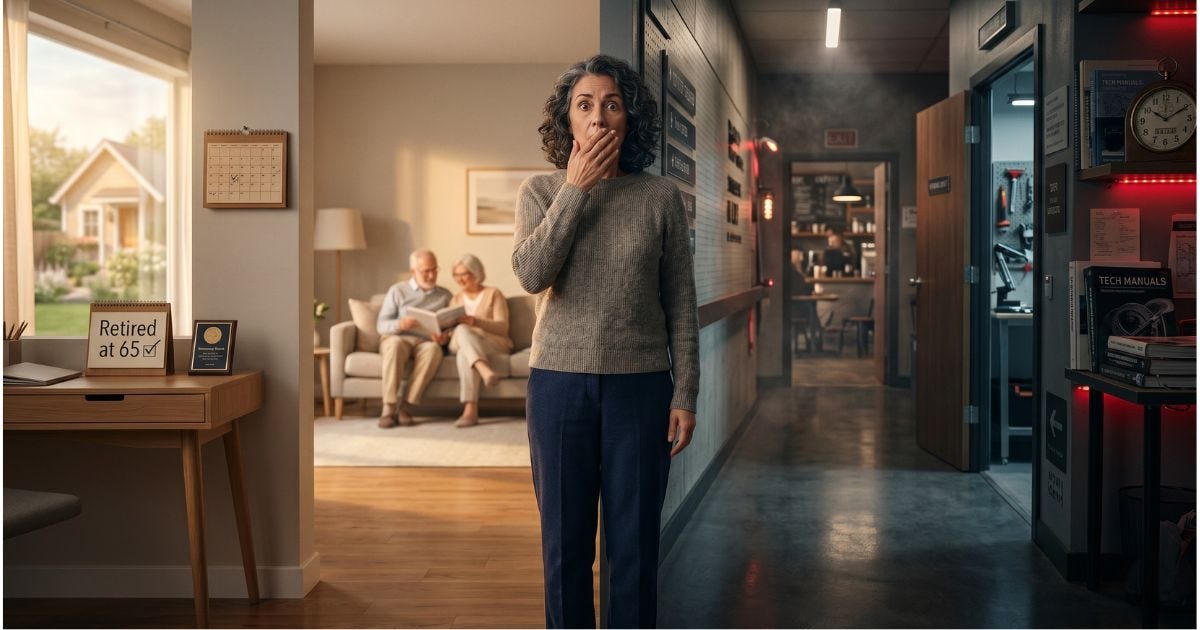
It’s entirely possible you’re planning your future with a picture of ageing that no longer exists.
For those of us in our fifties or sixties, this picture feels uncomfortably familiar …
It’s the version of ageing we watched in real time (or are still watching), our parents’ difficult, final few years. Their world is shrinking, their energy fading, they seem smaller and frailer, anxious and uncertain.
This becomes the mental model we carry forward, even if we never consciously chose it, an inherited image of what later life will look like.
So we expect retirement to follow a familiar arc: a decade or two of freedom and activity, followed by a gradual slowing, and then the final years marked by frailty and decline.
Makes sense, this might be the only retirement you’ve ever seen up close.
But if you’re entering the second half of life today, your future will look nothing like the one your parents lived. Planning and preparing yourself for the experience they had is, without a doubt, the single biggest risk in your financial life.
The assumption that trips us up
The real issue isn’t that you fear living longer. It’s that the mind uses an outdated emotional template to imagine what longer life looks like.
For our generation, our parents’ final decade is the only reference point we have for old age. Not through statistics or reports, but as lived experience.
We watched their world contract.
We watched strength fade.
We watched anxiety replace confidence.
That experience becomes your silent blueprint not consciously, but emotionally.
So when I suggest to a client that her planning horizon should extend well into her nineties, her reaction is immediate and visceral: a look of dread, a quiet “I don’t want that.”
She isn’t imagining her nineties.
She’s imagining her parents’ nineties.
We don’t fear longevity. We fear repeating our parents’ final years.
And that reveals the broken assumption at the heart of modern retirement thinking: the future we imagine has almost nothing to do with the world we are actually ageing into.
The world you’re ageing into is not the world your parents aged into
If you look around, it’s clear we’re ageing into a very different world from the one our parents lived through.
Not just in lifespan, but in what’s medically possible and when.
People in their seventies are functioning the way fifty-year-olds did a generation ago. We’re already seeing what this shift can look like. When Dick Van Dyke turned 100 recently, he remarked, “100 years is not enough you want to live more.”
Not because ageing has disappeared, but because vitality is lasting longer than the mental models many of us are still carrying.
Disease is being detected earlier.
Recovery times are shorter.
Interventions are becoming more precise, personalised, and proactive.
And the real acceleration is only just beginning.
What if the picture you’re carrying of your eighties and nineties is simply wrong?
Not long ago I would have said many of the coming breakthroughs were “ten to twenty years away.” Based on what we’re seeing now, five to ten years is increasingly plausible. And crucially, a number of them are already here …
Joint replacements transitioning toward outpatient, robotics-guided procedures — repairing what was once a six-month rehabilitation in a single afternoon.
Early-stage cancers detected long before symptoms appear, using imaging resolution and algorithmic diagnostics that consistently outperform specialists.
Cardiovascular risk identified years before a cardiologist would have known to look, turning late-stage crisis into early course-correction.
Regenerative therapies beginning not just to slow decline, but to restore function.
These aren’t sci-fi predictions. They’re present reality unevenly distributed, but real.
Researchers call this shift the extension of ‘healthspan’, the period of life spent in good health. Ageing hasn’t disappeared, but the old picture of ageing has.
Decline is being pushed later, compressed into a much smaller window.
Which means your eighties and nineties are unlikely to resemble your parents’ experience at all.
That changes everything about how you should feel about a long life.
A longer lifespan a gift — if your WealthSpan is designed for it
A longer, healthier life isn’t just about having more years. It’s about having more years where you’re strong, independent, and able to live the way you want.
A longer, healthier life gives you:
more years of contribution
more time with people you care about
more reinvention
more purpose
more life in your life
But it also brings:
more years that must be funded
more exposure to market cycles, inflation, and policy shifts
more compounding — of good decisions and bad
more places where outdated assumptions quietly fail
The challenge isn’t living to ninety-five. It’s living well to ninety-five. And that doesn’t happen by accident.
If your Wealthspan has been designed deliberately — back in your fifties and sixties — those additional years become years of freedom, independence, and optionality.
If it hasn’t, they become the contraction years, the uncertainty years, the “what can we afford to do now?” years.
A longer lifespan isn’t something to fear. But it does demand a planning framework built for a world your parents never had to navigate — not the outdated tools the financial industry has been using for the past forty years.
That alignment — between your lifespan and your financial span — is what WealthSpan is ultimately about.
The danger isn’t living longer — it’s planning as if you won’t
You’re ageing into a world with more years, more transitions and reinventions, more market cycles — and far more international policy surprises — than your parents ever faced.
A longer life magnifies everything: your opportunities, your risks, your options …
and the consequences of outdated models.
But that’s not the core problem.
The financial frameworks your accountant and investment adviser were trained in — and still use today — were built for your parents’ world, not yours.
They weren’t designed for a 40- to 50-year retirement, or for a world where change moves faster, cycles compress, and uncertainty is the rule rather than the exception.
Innovations now compress decade-long adoption curves into months. AI is the most obvious example — a technology we treated like background noise for years is now embedded in almost everything we touch.
Markets can move more in a week than they once did in a year.
Information arriving faster than you can evaluate — often with more noise than signal.
Foreign government policy decisions now ripple into your financial life far faster than earlier generations ever faced.
Uncertainty isn’t a background factor anymore. It’s the operating environment.
And planning as if the future will behave like the past is now the most dangerous thing you can do.
This is the hinge.
A longer life is a gift — but only if your Wealthspan is designed for the world you’re actually ageing into.
Which means your challenge — and your opportunity — is to adopt planning tools built for uncertainty, not predictability.
Because the danger isn’t living longer. It’s assuming you won’t.
And that is where we turn next: a planning framework designed for long lives, uncertain environments, and the real risk of running out — not just of money, but of opportunities.
That’s what we’ll explore in my next letter.