
If you’ve read much of what I write, you already know the punchline on longevity: you’ll very likely sail past the mid-80s that life tables quote, and arrive there in better shape than your parents did. Take that as read.
But here’s the lightbulb.
If a healthy sixty-year-old has thirty or even forty years in front of them, many of them good ones, then sixty isn’t the beginning of the end. It’s half-time. Middle age now starts at sixty.
Which raises an awkward question. You planned the first half on purpose -- the career, the house, the family, the building of the thing. Milestones, deadlines, sacrifice, intent. The second half, most people back into by accident, which, when you arrive there and realise it, can translate to regret.
The view from the second half
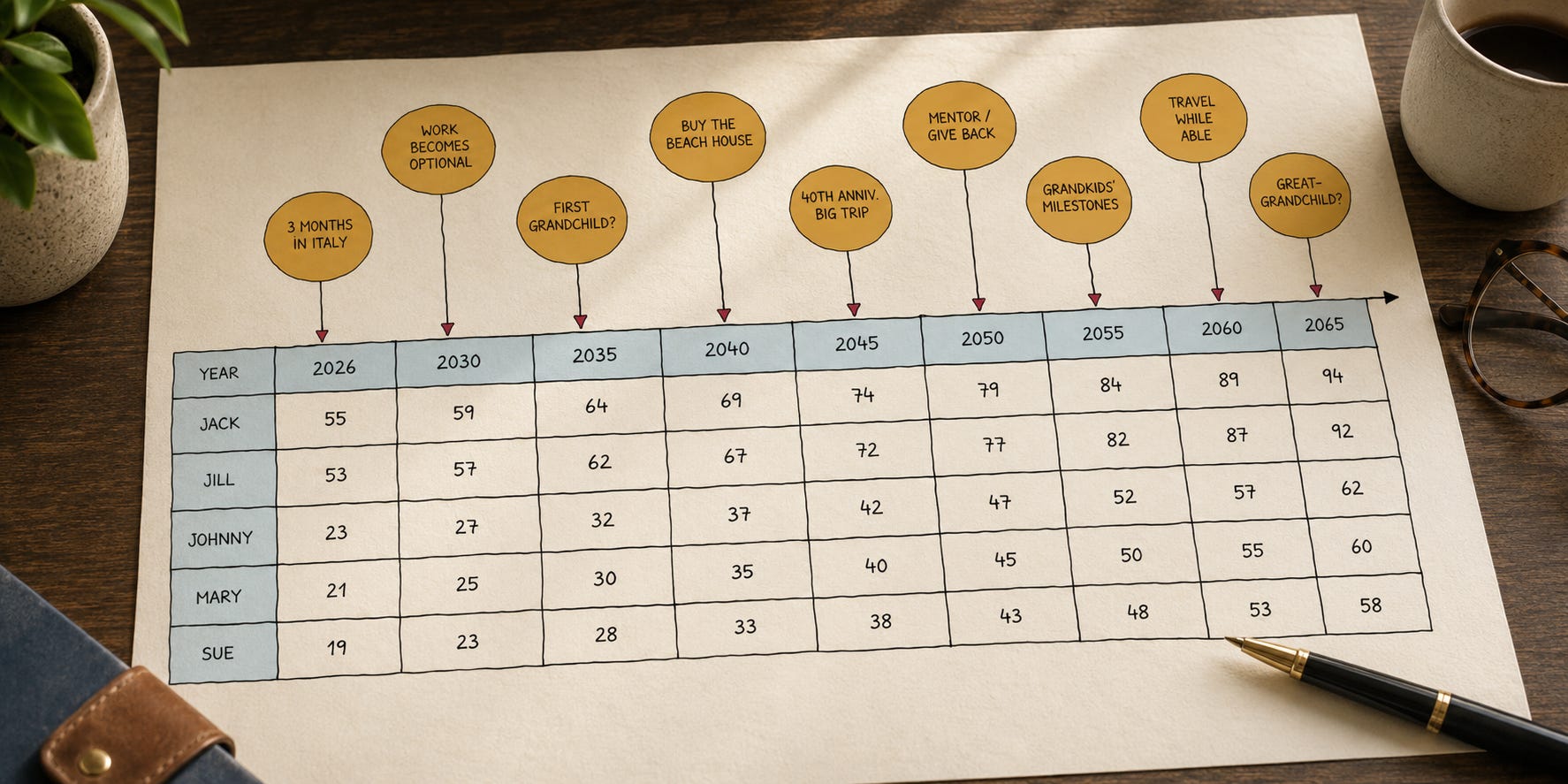
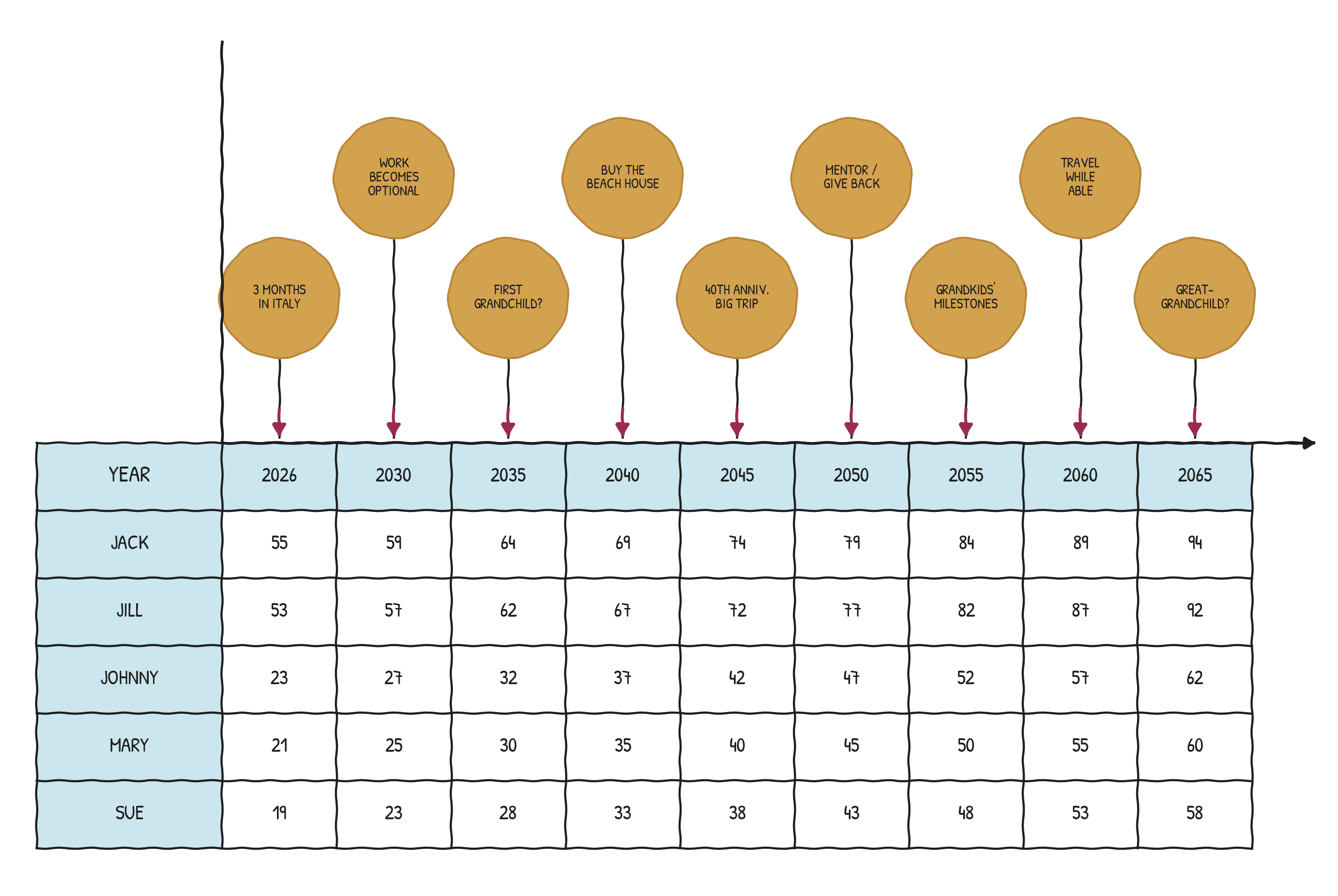
A blank page, a horizontal line across it for the years ahead, a row below that line for each of the people you’re responsible for -- your spouse, your children, anyone who leans on you or you have a big interest in. Starting at the left-most point, everyone’s age today. Then you walk the years to the right: five on, ten, twenty, thirty.
Somewhere around the third column, people stop seeing a chart and start seeing their life. The daughter who is nine in the first column is forty-three by the end of the page, with children of her own beside her. The parents you’re quietly keeping an eye on appear, and then at some point don’t. And there, still on the line, is you -- eighty-nine, and present for all of it. Not a projection of a balance. A projection of a life, carried decades forward in a single glance.
It’s not morbid. It’s context.
What you can see is how much is still in front of you, including the people who matter to you. You’ll most likely be there when your children reach the age you are now. You may well watch a grandchild reach middle age. That’s not a countdown. It’s an astonishing amount of life -- and it is the thing your planning is actually for.
Planning your money starts with planning your time
Most people have never looked at their future this way. They’ve looked at their money this way a hundred times.
Certainly I have; I spend my working life on the financial machinery for people -- the structures, the forecasting, the question of whether the money will last, no matter what. Last for what? And that’s the point.
Money is a serious asset and it rewards serious attention: it can be grown, protected, restructured, insured, passed on. Every part of it answers to effort and good planning.
But time is the only thing you don’t get to replace. You can’t earn more of it, you can’t insure it, and you can’t buy back a single hour at any price. You can be the most careful steward of money alive and not add one day to that line.
We all know this intellectually, but as we get older we start to actually experience the scarcity – and the value – of time. Precisely for these reasons.
This is what’s so criminal about the flawed notion that you’ll be doing very little in the years approaching your mid-eighties, and therefore you don’t need to plan for them because the decline will look after itself.
Whereas the truth is that if you approach the future we’re all really ageing into, rather than the outdated one you imagine you’re going to have, your second life can be vibrant and rewarding. We’ve been conditioned to believe retirement is a process of wilting, but it’s becoming increasingly likely this is a long period of life when you’ll have the time, the energy, and the money, to pursue what’s genuinely important to you. More like a blossoming.
Avoiding Ground Hog Day
Your timeline helps put this into perspective. It does that by entertaining the possibility that you’re going to be an accidental centenarian, forcing you to look at how your life today might play out on a longer timeline than expected. In turn, you clarify what’s important to you, personally.
This is what starting with the end in mind looks like.
Skip that by going straight to the money – how to improve performance, reduce tax, optimise structure – and you very quickly sink into the noise. It feels like diligence but it’s putting the cart before the horse and it leads to a type of Ground Hog Day frustration, having the same problem to solve year after year, progress ever elusive.
So what does the other kind of planning look like? Not therapy, and not fantasy — and not researching better investments, either. I’m talking about deliberately projecting forward to the life you’re ageing into, then working backwards to blueprint it.
It starts where the timeline starts: what matters to you, and who -- named, and placed in time. The events worth building your ‘second life’ around, set against the real ages of the real people you’ll share them with. Only once that exists does the financial question have any meaning.
How much you’ll need and when you’ll need it is all derived from that life, not the other way round. Start with the number instead and you’ve solved a maths problem without ever asking what the maths was for. Most financial planning, even very good planning, runs this back to front. Flip the order, though, and you’d be surprised how easily the financial plan falls into place — once the life is clear, the numbers finally have something to serve.
It doesn’t need to be complicated but it does need to be done because the person carrying the financial life is too close to it to step back and ask the original question. An outside voice -- with no product to sell and enough technical grounding to make the answers real -- turns out to be useful mostly for asking the obvious thing nobody’s asked.
Not everyone who sits down to it feels the floor shift, and you can’t fake the moment when it does. But for the person who’s ready, one honest hour can be worth more than a decade of statements.
If you’d like to see what a conversation like that looks like, you can do that here.
Whether or not you ever have it, with me or anyone else, the thing underneath it is worth sitting with.
A decision made now -- to pull out of the noise and do what matters, something that only you can do -- rarely feels dramatic at the time. Sure, you can have an epiphany and I’ve seen it happen – a satori that transforms your future in an instant. For most, though, it’s that essential one-degree shift in awareness and focus. Tomorrow looks almost identical to yesterday. But one degree, held over a long enough run, does transform your future – a different place on that timeline, surrounded by different things.
You’re likely to have more years than you think, and more life in them than your parents had in theirs. That’s the gift. The only question that matters is what you’ll spend it on -- because of everything you own, it’s the one account you can’t top up.
You can’t take it with you. You can, at least, decide what it was for.
-- Daniel Brammall
The WealthSpan Letter is general financial information, not personal financial advice. Consider whether any information is appropriate to your circumstances before acting on it.