

Probably your largest financial gift will be made via your will. Which means you’ll never see your nearest and dearest unwrap the gifts you spent a lifetime accumulating.
I’m not being theatrical or overly poignant here. This is how most family wealth gets handed down in Australia. Here’s the hiccup though …
The kids are usually in their late 50s or 60s when they inherit this semi-fortune. This is a time when – if they’ve played the Game of Life well – their mortgage is under control or all gone, their super is respectably well-stocked, and their own kids have left home for lives of their own.
Why make them wait?
Which is probably why these days I hear some version of this pretty often:
“We’d love to help the kids now. We just don’t know if we’ll regret it in 20 years.”
It’s a lovely idea, handing over a chunk of the inheritance now. Help with a deposit, knock down a mortgage, cover the school fees. Watch the money do some good while you’re around to see it, and while your adult kids need it, a lot. Why wait till you’re dead – it can change the whole trajectory of your kids’ lives plus their children’s too.
Trouble is, it’s not in the plan.
The plan says no
Most retirement plans are a straight line. Pick an average return, pick the age you’ll probably die, work out what you can draw each year, and rule a neat line from today to the end. It’s tidy, it fits on one page, and it describes exactly one future: the average one. Nobody experiences that future. It’s a made-up perfect middle ground.
And on that neat trajectory, $250,000 to each of the kids isn’t a gift, it’s an unrecoverable loss of altitude. Hand it over and the aircraft lands before it reaches the planned landing strip.
With that fear in the back of their minds, they – reasonably – don’t do it. But it goes further than that. A private decision to withhold largesse that would help the kids is not a light one. So, doubling-down, they tighten their own belts.
This is called Living Small. It’s one of the Four Horsemen of modern wealth, and the quietest of them because it looks like virtue. Nobody at a barbecue has ever copped a lecture about underspending.
It comes in two forms. The first is the one above: the big-ticket hesitation early in retirement, when anything that feels opulent, or just large, feels like it might tip the whole thing over.
The second creeps in later, ten or twenty years in. The capital isn’t what it was. The cost of living becomes a fixation, and every grocery docket gets read twice. You can see it in people who have never once been in real danger of running out, spending their eighties as if they’re about to.
The evidence says both are common. The 2020 Retirement Income Review found that many Australian retirees die with most of the wealth they retired with, and that plenty treat the minimum pension drawdown as a spending limit rather than a legal floor. For people who saved well, the usual failure isn’t running out. It’s never getting around to using it: the gift that waited for the will, the trip postponed until someone was too frail to go.
What ten million futures look like
The straight line’s problem is that it plans for one future. Sure, you’ll only live one. You just don’t know which.
Just ruling one line and hoping for the best is no way to plan a life. That would be like an engineer building a bridge without any stress testing or tolerance limits.
Any plan worth relying on should be able to answer the question: how much can we spend, in all the futures we might get, not just the average one?
Answering that question is definitely a job that falls to me, but I didn’t invent the technology that answers it because I can’t. Actuaries can, though.
So every year every client’s plan runs through an actuarial stress test that simulates 5,000 market sequences across 2,000 potential lifespans. This combines to ten million possible futures, with tax, super rules and the Age Pension allowed for in every year of every single one of them. Then it asks how much you can spend each year, rising with inflation, for as long as either of you lives.
Your ‘safe spending’ range
Unsurprisingly, the answer comes back as a range, not a number.
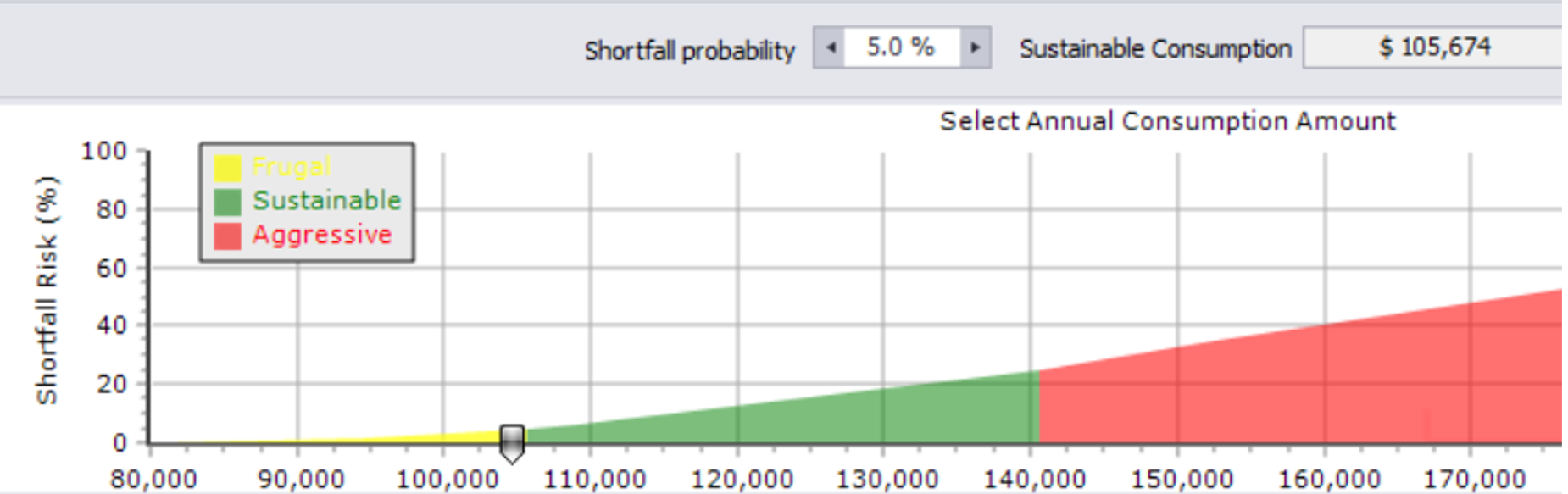
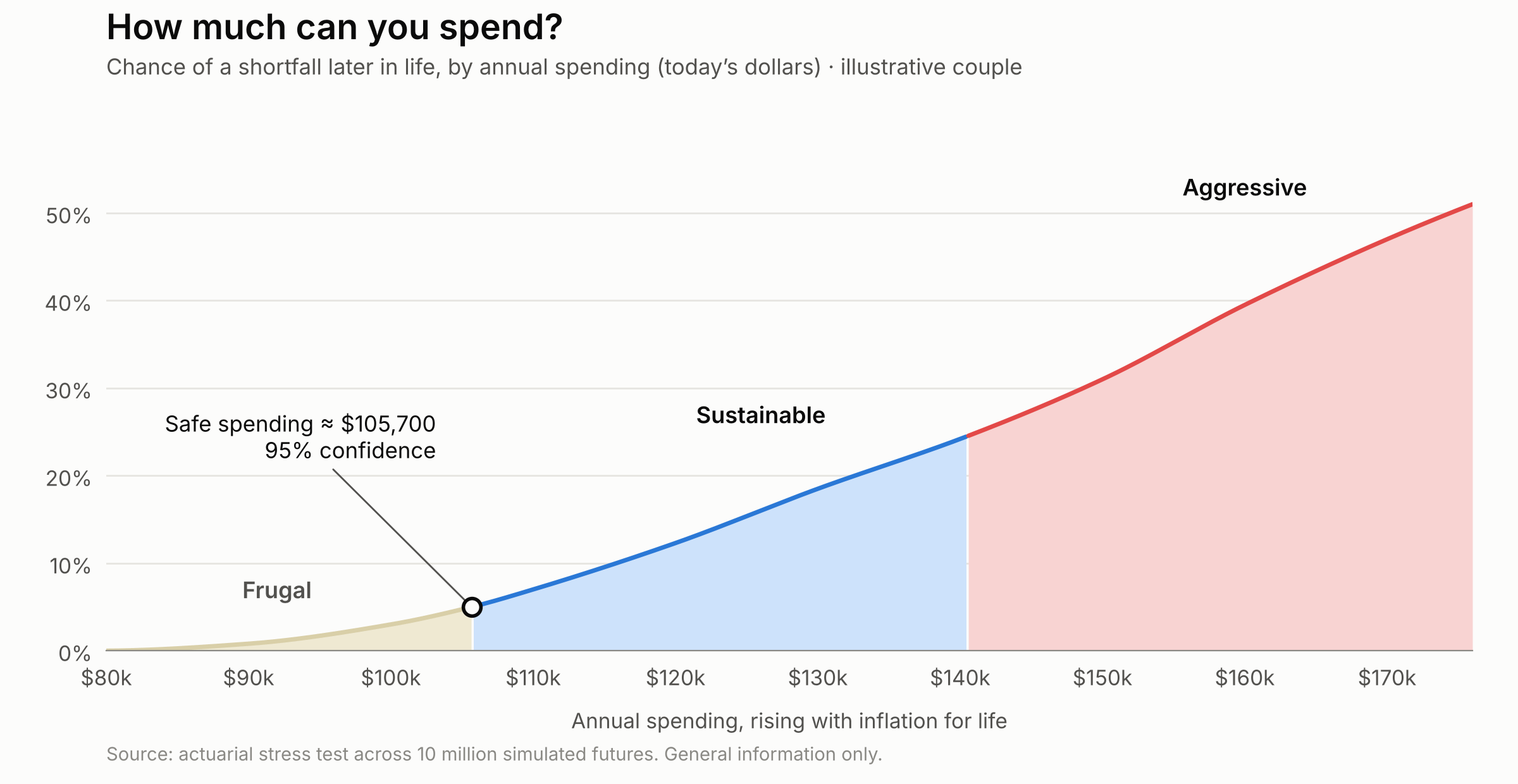
Annual spending (across) against the chance of a shortfall later in life (up). The marker sits at 95 per cent confidence.
For this couple, the floor was a bit over $105,000 a year, the amount that got them through 95 per cent of those futures. That’s a ‘safe spending’ range because it is derived from a 95% confidence level.
Then there’s a ‘variable spending’ number, that’s less certain. This is an additional amount of money that could potentially be spent, market conditions permitting.
If the ‘safe spending’ range is the salary then the ‘variable spending’ is the bonus. It’s a profit you can spend if markets are more buoyant than pessimistic. In good years the bonus is there to use or stockpile.
Two things on that chart change how people feel about a big decision. The first is how flat the line is at the bottom left. Cutting from $105,000 to $90,000 a year barely moves the risk (shown on the Y axis), from 5 per cent to close to nothing. Over a 30-year retirement, that’s $450,000 left unspent to buy almost no extra safety. This is called being too frugal (‘living small’).
The second observation to note has to do with the red zone, labelled ‘aggressive’. Spending in this range in good times and in bad is dangerous because it pushes the chance of running out prematurely up into the 25% to 50% range – from one in four towards a coin toss. It does not mean, though, that you can’t spend big now and again. If the market experience is good enough, though, then go right ahead. Fill your boots.
This framework operates like a twenty year early warning system that puts control back in your hands. Now you own a plan you are entitled to have confidence in.
The confidence to say ‘yes’
Run the gift through the model and the question changes. It’s no longer “can we afford to give the kids $250,000 each?” It’s “does that gift take us out of this safe harbour?” For our couple, after a couple of strong years, it didn’t. The gift came out of the bonus, not the salary. So they made it this year, because the plan’s stress testing stood up.
That’s the catch, and it’s also the point. The bonus is conditional. Had markets turned the year before, the answer might have been “not yet”, or “half now”. The decision rests on what markets have actually done, not on what the evening news says they might do next.
The same rerun answers the eighty-five-year-old reading the grocery docket twice. As the horizon shortens, the model works on the years actually left, and the safe number is usually more generous than the fear. Living Small at eighty-five is mostly a measurement problem, not a money problem.
If you’ve never seen a chart like this then it’s worth asking whoever looks after your money planning: who worked out how much we can spend? What would happen if it were more?
If the answer doesn’t inspire confidence, is it a plan or a guess with a spreadsheet attached?
Best regards
Daniel Brammall

Two ways I can help:
1. Roadmap Experience (Advisory)
Leave with clearer next steps and a practical path forward.
Book your call → danielbrammall.com/roadmap-experience
2. Countdown to Peace Calculator (DIY)
A quick quiz that scores how close your finances are to secure and future-proof, and what to focus on next.
Take the quiz → danielbrammall.com/ctp-calculator
The WealthSpan Letter is general financial information, not personal financial advice. Consider whether any information is appropriate to your circumstances before acting on it.