
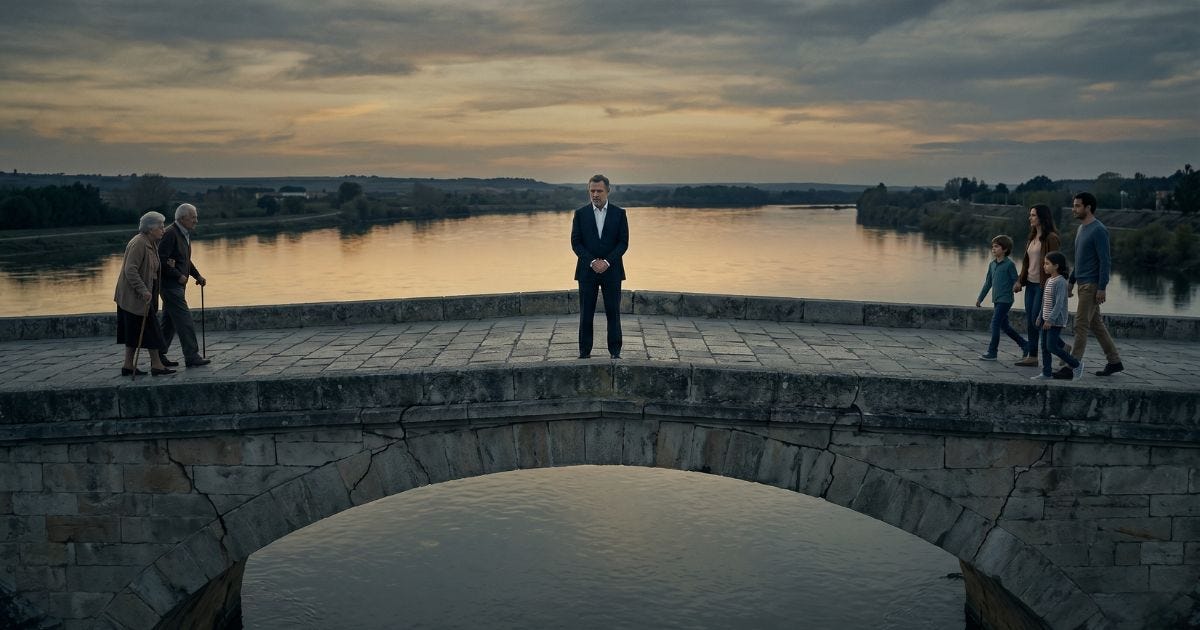
If you are between 55 and 65, and have built a level of visible wealth, there is an uncomfortable truth people in your position probably never hear:
You are one of the most exposed groups at this stage of life.
Not because you took reckless risks, did something wrong or failed to plan.
But because success quietly turns you into a load-bearing structure — for your family, institutions, and for future versions of yourself. It’s a ‘triple squeeze’ from your parents and your children, and the taxman.
Most people never experience this, they are buffered by systems, safety nets, or low expectations. You are not.
Plus you’re the first generation that’s had to do this.
Without a leg-up to your children on the property ladder, they’d most likely be spending most of their adult lives on the rental roundabout. Plus you’ve likely had to shoulder the burden of relocating mum and dad into retirement accommodation (and nursing accommodation thereafter). All the while, navigating your own retirement.
Success doesn’t remove risk. It concentrates it.
By your mid-50s or 60s, financial success creates a peculiar inversion. From the outside, you appear insulated:
assets accumulated,
income history established,
advisers telling you you’re “on track.”
But structurally, the opposite is true.
You now sit at the centre of multiple, overlapping obligations — many of which did not exist when your planning frameworks were first put in place.
You may be supporting ageing parents whose health, housing, or care needs are becoming less predictable and more expensive.
At the same time, you may be supporting adult children who are later to launch, slower to stabilise, and far more exposed to housing, employment, and policy risk than previous generations.
In between sits you.
Your capital.
Your earning power (or what remains of it).
Your ability to absorb shocks without permanent damage.
There’s an old saying: if you want something done, give it to the busiest person in the room. Over time, families tend to operate the same way.
When parents need help, they turn to the child who is most capable. When adult children need support, they lean on the parent who is most stable.
Competence quietly attracts dependency, often without discussion or permission.
So you are the bridge between generations — financially, emotionally, and practically. And bridges fail not because they are weak, but because they are asked to carry more load than they were designed for.
The myth of “Easy Street”
One of the quiet cruelties of success is how invisible its risks become — especially to people who aren’t living them.
From the outside, wealth looks like freedom.
From the inside, it can often feel like responsibility.
You don’t just have more assets. You have more at stake.
More concentrated property exposure.
More visibility to tax and policy changes.
More downside if markets misbehave at the wrong time.
More irreversibility if mistakes are made late.
A small planning error for someone with little capital is inconvenient.
The same error for someone with accumulated wealth — at the wrong point in life — can permanently reshape outcomes not just for them, but for the people who depend on them.
This is why the idea of “Easy Street” is so misleading.
Wealth does not reduce fragility. It often amplifies it.
Why “on track” feels thinner at the top
If you’ve felt a quiet unease despite reassuring reviews, this is why.
Traditional planning language — targets, projections, average outcomes — was built for a world where:
retirement was shorter,
lives were more linear,
and responsibility tapered with age.
That is not the world you’re ageing into. You are facing:
longer lives,
messier transitions,
overlapping financial dependants,
and fewer clean exit points.
So when an adviser says “everything looks fine,” part of you notices what isn’t being discussed:
What happens if care costs spike?
What if markets disappoint early, not late?
What if longevity stretches well beyond assumptions?
What if adult children need help at the same time parents do?
The plan may still “work” on paper. But paper plans don’t carry load. People do.
And the heavier the load, the less margin there is for error.
This exposure is structural, not behavioural
It’s important to be clear about this.
This is not a warning about poor decisions or lack of discipline.
In fact, the people most exposed tend to be conscientious, prudent, and organised.
The risk comes from where you sit in the system, not how recklessly you behave within it.
You have:
assets that attract obligation,
success that creates dependency,
and time horizons long enough for uncertainty to matter. A lot.
The irony is that the very qualities that produced success — responsibility, foresight, resilience — now increase the consequences of getting things wrong.
That is the exposure trap.
Why the old planning logic starts to strain
Most planning approaches still organise decisions around optimisation:
maximise returns,
minimise tax,
smooth volatility,
reach a number.
That logic worked reasonably well when the problem was accumulation.
But when the problem becomes carrying responsibility across decades of uncertainty, optimisation starts to look like the wrong organising idea.
Optimisation assumes:
a knowable future,
a narrow range of outcomes,
and the ability to correct course quickly.
None of those assumptions hold particularly well for people in your position.
When you are the load-bearing structure, the real risk is not underperformance.
It is fragility.
A plan that looks efficient but lacks resilience and adaptability can fail under stress — even if the averages look fine.
And this is why high-net-worth unease often has nothing to do with fear, greed, or ignorance.
It is a rational response to carrying more weight in a more uncertain world.
Where this leaves us
If planning were still about hitting a number, the old methods would suffice.
But for people who are financially successful, responsible for others, and likely to live far longer than previous generations, the task has changed.
The question is no longer: “How do I optimise outcomes?”
It is: “How do I structure financial decisions so they can endure — across uncertainty, responsibility, and time — without shrinking the life I’m trying to protect?”
That requires a different organising principle altogether. And once you see that, it becomes impossible to unsee.
This is an excellent description of my present challenges.